Not really, but once you’ve experienced the claustrophobia-inducing bus rides, the I’d-rather-chew-on-my-weenis-and-sacrifice-loved-ones-than-stand-here-for-two-days ticket lines, or the, we-have-a-toliet-but-you-can’t-use-it-now-because-we’re-so-overbooked-that-thirteen-people-are-sitting-in-there-for-the-duration-of-the-twelve-hour-ride train rides, you may think my translation is a bit more appropriate.
Insert obligatory Waldo comment here.
Just sayin’.
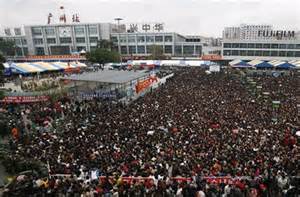
I’m missing Xi Yang Yang Hui Tai Lang for this Sh#t? Credit: news.cn
The Lunar New Year is the BIGGEST holiday for Chinese people. Spring Festival (Guo Nian) is the celebration of the new year, and everywhere in China you can see more red than usual, doorway hangers with meaningful and auspicious phrases greet guests as they enter homes, and many kids and business men will receive little red envelopes with crisp, clean bills in quantities of 100-1000 RMB.
Credit: baidu
As the legend—there’s always a legend in China—goes, Nian was a great and terrible monster that harassed a village, eating its people and basically causing the real estate market to crash. He did this for a while until an old man convinced him to switch his diet to other creatures that weren’t…human. The man turned out to be an immortal—there is always one of them running around in Chinese myths, too—and, additionally, told the people how to scare off this beast if he ever returned.
Wear a bunch of red, make noise, and light things on fire was his advice, and the Chinese have held true to these sage words so well that, for a week during this holiday, some Dalian neighborhoods resemble what I imagine downtown Baghdad might look like. Sulfur fills the air, conversation is blotted out by explosions, and flashes of light illuminate the sky. And occasionally a pedestrian gets fourth degree burns and street cleaners lose phalanges.
Guo Nian, once known as the “passing of the beast,” now mostly just means Spring Festival, but it’s fun to know the source, ain’t it?
Stories and myths are nice and all, but when you’re standing or squashed hip-to-hip with smelly strangers or sharing the bathroom with seventy other dudes, you come to learn that a new beast has appeared in China, and like Nian of old, it comes around once a year to ravage even the most civil of citizens—Chun Yun, Spring Festival Travel Rush.
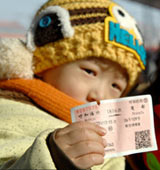
He’s little! Just stuff him into the overhead luggage compartment! Credit: thechinawatch.com
Families, students, migrant workers, and tourists all travel in China during Spring Festival, which usually falls around the first week of February. Some will fly, drive, take buses, trains, ferries, or even hitchhike to get back to their dear mom and pop.
High Ho, High Ho…Yeah, I know, one short.This is the classic bag of the min gong, migrant workers.
Airlines here are being, “…instructed to take measure to avoid flight delays as the world’s largest annual human migration…draws closer…”(Wang, Chinadaily.com.cn), but in a country of so many, and a severe pollution problem that routinely grounds and delays flights out of big cities, this “instruction” might just be wishful thinking. Heck, Shanghai alone is projected to have more than 9.3 million travelers pass through (Chinadaily.com.cn). That number might not seem so scary, but consider that Shanghai is just ONE of hundreds of cities with airlines in China. Still not convinced? Then think about the most popular form of travel: the trains.
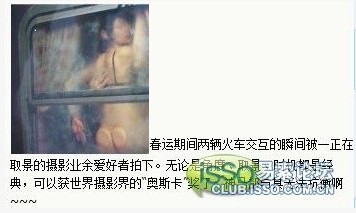
Some guy took a shot of this as two trains were passing each other. Can’t really beat the truth. Credit: baidu
Last year more than 220 million passengers took to the trains, and this year already more than 148 million tickets have been sold for these suicidally filial citizens (Chinadaily.com.cn). At its peak, more than 500 train tickets a second were sold! To put that in perspective—I have no way to cognitively register such a number of sweaty, pushy, humans—in the US this year AAA projected that about 94.5 million people traveled 50 miles or more during the Year-End holidays, and we Americans don’t even like trains—that number is a total for ALL travel forms (Newsroom.com). Less than 100 million compared to more than 220 million…That. Does. Not. Compute.
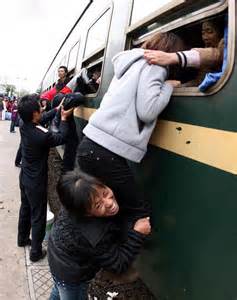
Her brother is already in the luggage compartment. Just stick her in the toilet! Credit: http://www.fashion-bop.com
Living in China introduces you to myriad situations that test your gumption and resolve, but nothing zaps the will so much as the sheer force of numbers. I’ve avoided markets and stores until I was about ready to boil the leather of my shoes, just to not have to deal with people. I’ve walked a block out of my way instead of allowing myself to become part of the anarchy that is the pedestrian parade crossing the street. When I see a China-size crowd, I feel like I need a pep talk from Jesus telling me not to take a machete and cull the multitudes.
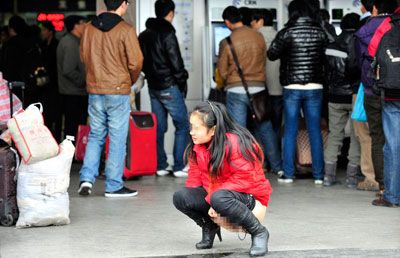
Yup…It was either this or lose her spot looking for the bathroom. Credit: baidu
That being said, there are three reasons that people smarter than me blame for the rage-birthing throngs in China this time of year. Besides the simple answer of This Is China, or “Damn that’s a lot of people,” three reasons do stand out as the origins of so many annual aneurisms:
Traditions of traveling back home.
Education/Work reforms that promote students attending universities in other cities, and large numbers of workers that travel city to city for work most of the year.
Spring Festival, along with the Golden Week of the National Day holiday in October, are two holidays that EVERYONE has off. Because of this, they like to take their trips during these times as well as visit the ‘rents (Coonan, “Two billion journeys in China’s own great migrations”).
China is aware of these issues, and, believe it or not, they are working on it, but this Spring Festival travel season is already upon us, and all I can say is, “God’s speed to you crazy commuters, you.”
Oh, crap…I’m going to be traveling, too!!
“Yo, foreign devil, I hear you’re lookin’ for one of these…How much is in your wallet?” Credit: Baidu
Weibo, China’s answer for its American counterpart, Twitter, is largely comprised of Chinese language speakers. In 2012 there were more than 500 million users on the site and about 100 million messages posted daily (Josh Ong, TWN). Today they got one more to add to the stats, a goofy American.
The Chinese version of the site isn’t exactly easy to navigate, even with the additional support of Google Chrome’s attempt at translating the pages, but I figure why not look into it anyways. Though I’m not necessarily a tech-savvy individual, the goings-on in the Chinese blog/web-o-sphere fascinate me.
I’ve written once before about aspects of China’s censorship issues on this blog, and sure enough, Weibo hasn’t escaped unscathed in the Middle Kingdom’s war on the combating of “inciting rumors,” as they like to refer to it. Last year in the news, the govt. said that they would require all users to register with their real name and even their ID number (http://asia.cnet.com/blogs/foreign-users-of-weibo-in-confusion-as-chinas-real-name-deadline-looms-62213416.htm). Quite understandably so, most people were a little miffed about this.
This change in the registration process was supposed to take place last March, but if you checked out the linked article, you’ll see that foreigners with our damn foreign names were in somewhat of a Weibo purgatory, a Weiburgatory, if you will. And even now there are still stirrings saying the policy could take place. Will my profile be frozen or blocked? Will I—Intrepid_Nomad (my Weibo Nickname)—be another of the site’s statistical burps? Or will I be able to hang around the site and play a while?
It’s not like I’m planning to spread dissent throughout the ranks of the microbloging netizens or anything fancy like that. Since joining a few days ago, I’ve only made a few innocuous posts about beginning work again, and I posted a few photos from trips in China I’ve taken. Within minutes the posts were viewed about a hundred times each, and the numbers keep changing, but I doubt any of the thousands or so full-time Censors are counted among those views. Most likely the posts didn’t even illicit a beep from the keyword software Weibo and the Great Chinese Firewall use to monitor searches and the publishing of sensitive content. Well, one of the tags I have is “American,” so…Yeah, maybe they’ve started their dossier.
Keyword recognition software being used for censorship isn’t new, and isn’t even particularly Chinese, but it is used quite a bit here. As anyone in China can attest, most Western social networking sites are blocked. Facebook and WordPress, Twitter and Tublr—you ain’t surfin’ them unless you’ve got yourself a VPN. But of course it isn’t just these sites that are blocked. No, as Econsultancy writer Ben Davis points out, on any given day in China you can’t freely peruse topics that pertain to:
…Chinese politics (human rights etc), socially sensitive content (pornography, gambling etc), people (dissidents), sensitive events, technology (spyware, URLs etc) and other miscellaneous topics.
As you can see, these are pretty general topics that most Americans or web users routinely look up. In China, though, looking up any political leader can get you a slap on the wrist. Checking in on Tibetan protests might do more than slow your internet connection speed. Claiming affiliation with a known activist group or promoting religious views—total no nos.
Apparently it’s not okay to look up “Xi Jingping in a tutu singing Madonna while drinking Baijiu.”
That being said, people are crafty. Chinese netizens are sly and still do talk about all of these topics, just not in obvious ways. The Grass mud horse (Cao ni Ma—in pin yin) is a great icon for the Chinese blogger who wants complete freedom of speech. A homophone for “mother fucker,” the meme became the animal of the Censorship Fighter on the Chinese net a few years ago. It’s still around, too.
Using the Chinese characters for 6 and 4, people have been able to write and search for info on the June fourth Tiananmen incident. Using euphemisms so veiled that even fluent Mandarin speakers aren’t always sure of their meaning, ideas are passed around and the Great Fire Wall is hopped over like a backyard fence.
Talk to your parents; we’ve done this once before and it didn’t end well for the people outside of this tank.
Even with censors, in 2011 Weibo was used in a way that even Wikileaks would be proud of. When a high-speed train collision in Wenzhou that killed 40 people was being swept under the rug Weibo users took to the net and lambasted the government for the cover-up. People were criticizing the government’s actions on a scale never before seen in China, and people realized it. Information was spread.
Weibo didn’t remain so open, though. It has been, like all of the Chinese Internet, subject to severe and speedy censorship. Even after the “Real Name” policy got put on hold due to the outpouring of user (domestic and international) criticism, the censors didn’t go away. In recent months, though, that censorship is changing. According to Jason Q. Ng at Tea Leaf Nation, “Through the testing of searches of key “sensitive” terms on the site, it has become clear that some previously-blocked search terms now return results.”
He goes on to squash the celebration by saying that the strategy has changed, not the end goals. These “results” are heavily filtered, sanitized, and censored. Now you can pull up info on June 4th, Xi Jingping, and a few other “sensitive issues,” but what you’re getting isn’t objective answers. Jason Q. Ng sums it up nicely by saying,
Before, Chinese users knew when their results were extra sensitive (most, if not all, Chinese users are aware that censors routinely work behind the scenes to delete sensitive posts), yet the new changes – combined with other tactics documented by GreatFire like only showing search results from verified users for certain terms and delaying posts from appearing in search results – create even more uncertainty as to the boundaries of discourse online, perhaps encouraging greater self-censorship by users. What is and is not off-limits has now become slightly harder to determine – another step in making censorship invisible and all-pervasive.
In a country with the insane population numbers of China, the uneducated are a large demographic. Rumors that start on the net can spread and cause serious damage if not monitored. Those who have no way of forming their own views can be guided to think and believe just about anything. It’s happened all around the world before, and it’ll probably happen again. I suppose I get that, to an extent. A country does have to have the ability to be objective, and if that means admitting to itself that your citizens are too incompetent to make informed decisions, than that’s one thing. Some of the censorship in China is up this alley.
You don’t know enough to know this is bad, so I’m just gonna do you a solid and take away those silly new thoughts this might give you…
But not all, or even most of it. When you take away objective, educated journalism or news, that’s when the fit hits the shan. Now they’re taking it further and doing a form of “reeducation” by allowing searches that produce authorized results. People notice these things. They’re treated like sheep, but not all of them follow the shepherd so closely.
And the truth is: people here are curious. Hell, they’re more than curious. I’ve spoken to Masters students who have aired the issues they have with Chinese censorship, and I’ve seen the looks my Business Education students have given one another when the conversation has strayed into territory that is not supposed to be discussed openly.
The government knows its people are restless, too. In 2004-2006 a talent show called with the English name Super Girl allowed people to call in a vote for their favorite contestant. The show was a lot like American Idol, and it had viewers tuning in in the hundreds of millions. The democratic one-call, one-vote platform was too much, though. Chinese officials cancelled the show, and even its second reincarnation, Happy Girls. The official reasons were due to timing issues and the “risqué” nature of some of the episodes, but it was pretty obvious when it got the axe that seeing such a large percentage of its citizens taking part in something so democratic was not what China wanted (China Cancels Talent Show ‘Happy Girl’ For Being Too Democratic, Business Insider).
Linette Lopez’s article for Business Insider had another great quote, too, “Some people sight that if only we could vote in Chinese elections, as we do in ‘Happy Girl’, then we’d lock horns and join the contest…This is the truly sensitive issue.”
The people know all the faults in their system, and people in other countries are foolish if they think otherwise.
That’s just it, though: it’s their system.
Living in China for a few years does not make me any closer to being Chinese. Learning the language will not grant me the Golden Ticket into this culture. Joining Sino Weibo and having a WeiXin account does not give me any sort of street cred. It does, however, give me a more scenic seat.
In her recent book, “People’s Pornography: Sex and Surveillance on the Chinese Internet” Katrien Jacobs sheds a lot of light on the interesting worlds surviving and thriving behind the Great Fire Wall on the net. The Chinese people may seem docile and complacent in the face of an oppressive, secretive, and Big government, but that is only what they appear to be. They are quite a bit more. Their lot has forced them into challenging the system in unique and unorthodox ways, and, yes, many have taken large gulps of the Mao Era Cool-Aid, but there 300 million bloggers (about the population of the entire US) out there trying to find something of an individual identity. Some are whispering and others shouting. There are the voyeurs and the voices, the loners and the leaders, and they are pushing against the boundaries that have been placed around them.
It’s going to be interesting to see how much pressure the “Great Fire Wall” can take when the people inside it are pressing against it, trying to get out. Will it stand the test of time like The Great Wall, or come tumbling down like the one in Berlin?
I’m just hoping that doing research for this entry without my VPN doesn’t get me deported and my new Weibo account deleted.
Oh, and I got a new tattoo while visiting America recently.
If it’s possible to be nostalgic for the future, as a teenager, I managed it.
For about five years, on December 31st, I would round up the four or five closest people in my life and force them (on more than one occasion threaten them) to pen an epistle to their future selves. Each year the “To be Opened” date was randomly selected. I think the first time around was when I was 16. Patience wasn’t a strong virtue of mine then (nor is it one I champion now), so I think we wrote to two years into the future. The next time around was maybe three. And so on.
The first group to be strong-armed into this included my brother, best friend, girlfriend, girlfriend’s cousin (my neighbor), and girlfriend’s cousin’s boyfriend. And me.
Madly in love with my girlfriend, I wrote largely about her. I threw in some obligatory concessions to family and friends, but mostly, it was to her. I don’t know what the others wrote about because I delivered their letters to them without prying.
The deal was that they’d write the letters and I’d seal them in envelopes and make sure they got them at the appointed time. Because we had planned to write them each year, burying them like time capsules didn’t seem practical. Instead, I placed them (alongside other childhood treasures like cards, middle school notes, an old pocket knife, and oddly enough, those Jaw-Dropper Magic infomercial VHS tapes) in an army tin and slid the thing under my bed.
True to my word, I never looked at the letters and I got them to their writers each time. Even after I broke up with the girl I had written about, I got her letter to her (and her cousin with whom I was not on speaking terms). The years went by a few more times, and the letter writing continued. The group changed, with a few of us staying and others going. In 2010 I got a group together for the last time and we wrote letters.
The group consisted of my best friend, mother, brother-in-law, my wife, and me.
I just found these letters today, lying at the bottom of the tin, under the Jaw-Dropper videos. They were to be opened on January First, 2013. That didn’t happen because I was in China.
Considering the changes that have taken place in all of our lives since their writing, these letters make me apprehensive. I’m no longer married, I’ve been out of the country for more than two years, and I haven’t seen my best friend yet since I’ve been home for a little more than a week. The rest of the group had a crazy last couple of years, too, so as I stare at the envelopes setting atop the desk I used to complete homework on in high school, I’m hesitant to read mine. I have no clue how to get the letters to the two others that I don’t see, and I’m not sure if my friend even wants his. I can hand my mother’s to her, but then what about mine?
In 2010 I had a life trajectory that I could see ahead into for years. By the end of 2013 that path has been demolished and built over so that now, I’ve got visibility for about a few months out or so. Not only is it a new path, it’s a route that wasn’t even on the damn map before.
As I wrote before: I count myself among the truly blessed to be living the life I want to be living. Even if it comes to an end sooner than I want, I have been able to lead the very life I have always wanted to lead. How many people can say that?
That being sad, there have been plenty of mistakes on my part. I’ve hurt people, and I’ve let others down. I’ve gone through pain and no small amount of stress due to the things I’ve done or haven’t done right.
And every time my eye catches the corner of the envelope hanging half off the desk, I’m reminded of these failures. I truly have no idea what I wrote about, but one thing is certain: I had no way of knowing the Jordan who would be reading the words written.
On this day, though, as is the heart of the holiday, I’m looking ahead as well as at what is in my past. I will read the letter, and I will let the words do whatever they plan to do, but then I will fold up the paper, tuck it back into the envelope, and put it back in the tin where it will stay. The tin will get slid back under the bed that is no longer mine, and I will go about my life.
I’ve got so much yet to learn from life that I can’t be consumed by the lessons of yesterday. Forgetting them would be equally foolish, but then again, I’ve never been one to let go of the past anyways. Instead, I’ll learn from the experiences and just simply let go of the baggage. I recently read a fantastic quote on a friend’s Facebook.
“Experience is not what happens to you; it’s what you do with what happens to you.” — Aldous Huxley
This is my motto for the coming year. Just decided it, and I feel good about the decision.
Where ever you are and whoever you’re with, take your experiences and do something crazy. Learn, Love, and Live in 2014!
*And because I won’t be able to get the song out of my head until Chinese Spring Festival, here’s a classic.*
Should old acquaintance be forgot, and never brought to mind ? Should old acquaintance be forgot, and old lang syne ?
CHORUS:
For auld lang syne, my dear, for auld lang syne, we’ll take a cup of kindness yet, for auld lang syne.
And surely you’ll buy your pint cup ! and surely I’ll buy mine ! And we’ll take a cup o’ kindness yet, for auld lang syne.
CHORUS
We two have run about the slopes, and picked the daisies fine ; But we’ve wandered many a weary foot, since auld lang syne.
CHORUS
We two have paddled in the stream, from morning sun till dine† ; But seas between us broad have roared since auld lang syne.
CHORUS
And there’s a hand my trusty friend ! And give me a hand o’ thine ! And we’ll take a right good-will draught, for auld lang syne.
CHORUS
Robert Burns.
English Version.
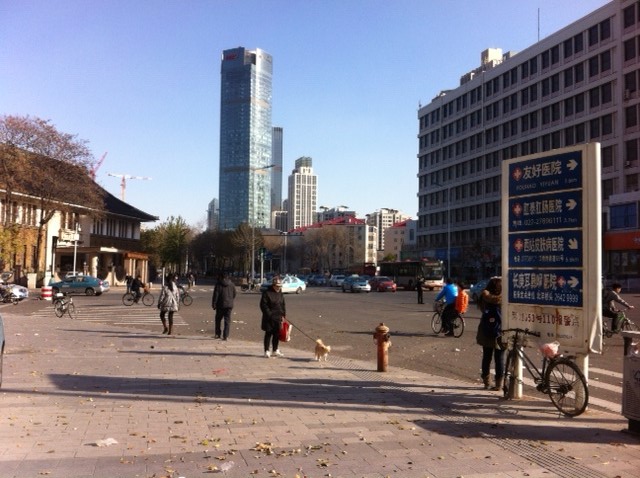
The only difference between this picture and most Chinese cities: Confetti. I should totally buy some when I get back and just start launching confetti into crowds and taking pictures. Yeah, that’ll work.
More than a month ago a colleague of mine, the High School Science teacher, sent out an e-mail detailing a bunch of Wikipediaed (it’s a verb, too!) info about Tianjin. The last line quoted plane tickets to the place at around 90 RMB from Dalian, one way—pretty freaking cheap.
I read it, said, “Hmm. That’s interesting,” and honestly didn’t think about it again for an entire week, until one night on the bus ride back to KFQ, another HS teacher asked me if I was heading to Tianjin with some of the guys in a few weeks. We talked it over, and, even though I went to Tibet not long ago, just purchased my tickets back to America, and was already planning a trip to Cambodia for February, I decided to head down to Tianjin with them.
In terms of urban population, Tianjin is the fourth largest in China, after Shanghai, Beijing, and Guangzhou. Tianjin is a dual-core city, with its main urban area (including the old city) located along the Hai River, which connects to the Yellow and Yangtze Rivers via the Grand Canal; and Binhai, a New Area urban core located east of the old city, on the coast of Bohai Sea. As of the end of 2010, around 285 Fortune 500 companies have set up base in Binhai, which is a new growth pole in China and is a hub of advanced industry and financial activity. Since the mid-19th century, Tianjin has been a major seaport and gateway to the nation’s capital. Tianjin also has an active night club and live music scene.
Air fare to Tianjin is as low as 90 RMB one way from Dalian. Contact M. Baldwin for more information about this thriving metropolis.
We all grabbed different flights, and they all got delayed…
It was passed midnight by the time we touched down in Tianjin, and almost one by the time the five of us regrouped and found a club.
By 4:30 most of the group had called it a night, but I stuck around a bit longer.
There were a ton of Russians, Ukrainians, Sri Lankens, Persians, and of course Europeans at the club. I have no clue why there were so many there, but on the second night Ryan and I caught a glimpse of some clashing of cultures.
That second day, morning came around one in the afternoon for some of us, but then the group caught up with each other and wandered for a bit until we found Hank’s Sport Bar and Grill. Hands down, best food I’ve had in a while. It’s an American-owned place, and Hank himself talked with us a while during our late lunch.
The consensus was that we’d go back to our respective hotels and nap away a few hours, and then regroup around nine to catch some live music at another club. Though I felt a bit like roadkill most of the day, I didn’t want to sleep. Instead, I wanted to go see Xiao Ming’s undergraduate university—Tianjin University.
I’d chosen my hotel because of its price and proximity to the school, and when I went off on my own I wandered around the campus a while. It’s a pretty campus, but in the evening, wind blowing like mad, there weren’t a lot of students just hanging around. Still, I managed to find myself—two times—engaged in conversation with curious Chinese kids. One girl and I talked a while about Tianjin and the school, and about Dalian. Another guy wanted to just follow me around for a bit. I’m pretty sure he wanted to follow me as I met up with the other four, but I indirectly told him to take a hike.
Day time shot from the next morning. This is in the open area of the campus
We found the Italian Style Street not long after nine, and then Club 13. The place had that local hang out vibe, the interior inspired by industrial warehouses and T.G.I. Fridays. Eventually I asked the owner why she chose the name, and she reminded me that 13, in the West, is considered a bad omen, so she wanted her patrons to think it a bit dangerous as they stepped into the place. She said this all with a smirk and thick sarcasm, so I have no way of knowing if it held any truth.
When the band took a break their buddy hopped on the stage and sang a few.
The band playing—a trio of young guys—turned out to be pretty good. The lead singer, a fast-talking local, seemed to constantly exaggerate the well-known Tianjin accent just to get a rise out of the audience. Another guy, the bongo drummer, wore a Jamaican-style shirt and Sesame Street pants. The guitar player drank a lot of water and told jokes between songs. They sang songs with lyrics more than mildly anti-government. It was great.
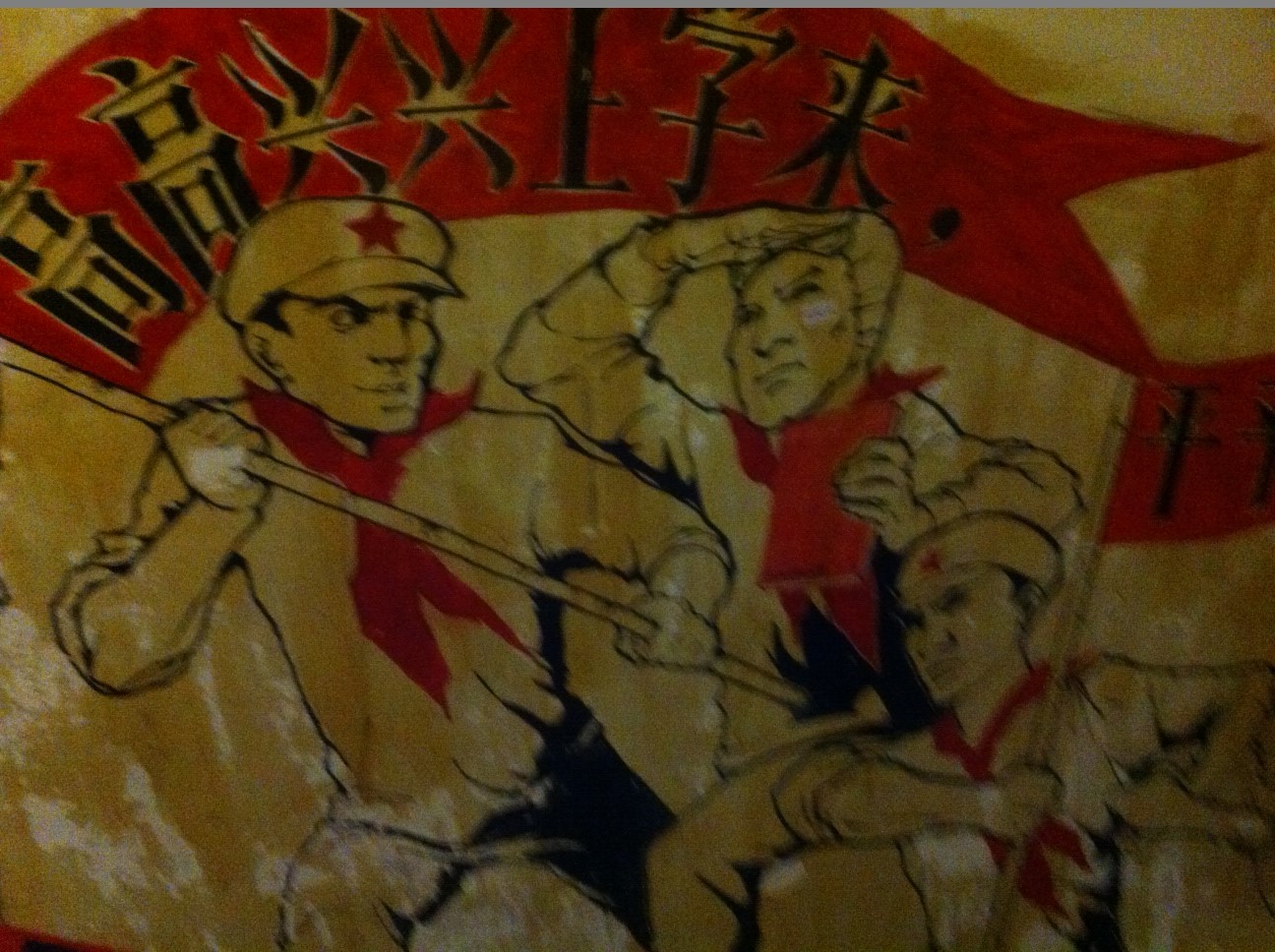
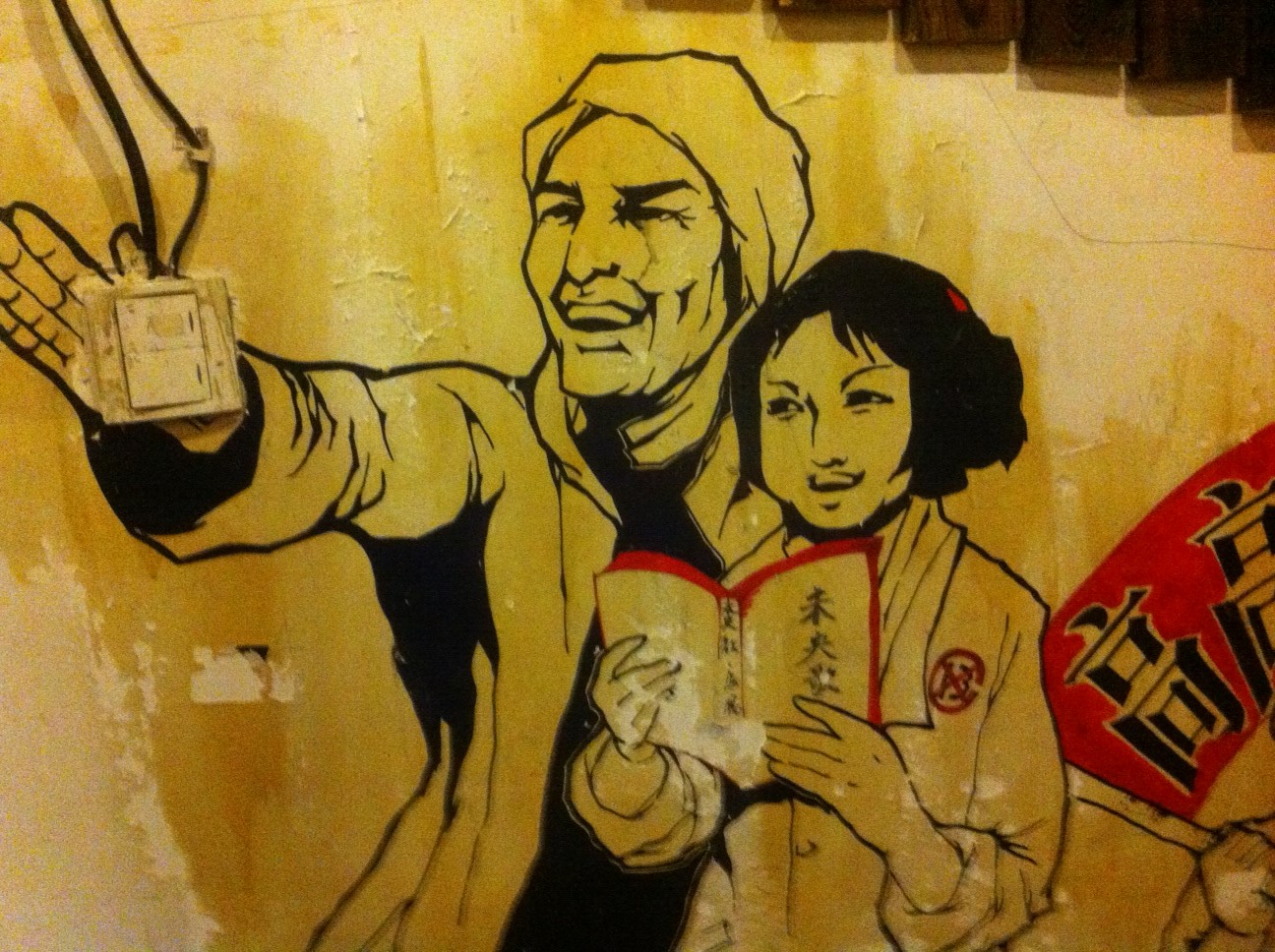
The place had communist murals all over the walls. They looked like traditional images, but they had a sarcastic feel to them.
After a while it was pushing elevenish and there was a decision to call it an early night. The workers and I had been talking throughout the evening and one even bought me a drink, so before we left I asked if they knew of any other places where we could hang out. They gave me animated instructions and recommendations (and a handful of their customer-friends chimed in) and eventually we got a lead on two more clubs to check out. Before everyone left, though, we realized Ryan was missing.
The place was closing down, so there wasn’t much noise at all. What we did hear, however, was the sound of two hand-drums being played. Following the sound, we found Ryan cradling a drum between his knees and jamming right next to the drummer from the band. They sounded great. It was completely improvised, but they really had a rhythm.
On the way out Ryan and I chatted with the workers and basically secured the opportunity to come back and actually play for the club. He gave him one of his CDs and as we all walked out of the club Ryan’s one-man-band Cronkite Satelite blared out into the Tianjin city streets as the girl played it over their system.
A look from the balcony of Club 13
Once the others left, Ryan and I followed the directions to a place called Helen’s, a restaurant by day and bar by night.
After taking an elevator to the third floor, we grabbed a table and ordered some food, taking in the crowd of dancers and diners. Once again, a large Sri Lankan presence could be seen, but this time things didn’t stay harmonious for long. About thirty minutes later, our conversation got interrupted as some of the sober Sri Lankans tried to help drunk ones to their tables. A Chinese guy got in the way, and then got decked, hard–twice. He sort of stood there a minute without doing much, but after his lady friend and his buddy checked on him he seemed to realize he needed to do something to exert his awesome manness. He went crazy.
Chinese and Sri Lankan alike duked it out in the restaurant while the staff and other hungry folks just ignored them—for like 15 minutes. Eventually, the Sri Lankans left, and the Chinese guy who got clocked settled. For a minute. At one point he tried to use a beer bottle as a club, but his group took it away. Somehow he managed to convince his table he had calmed enough to go out for a smoke.
About this time Ryan and I decided the show was over and also thought calling it a night sounded good. As we walked out of the building hollering and screaming reached our ears. Sure enough, the fight had migrated to the street. This time the swings were more furious and the rage a bit more entertaining. We watched a while, but when the cops showed we grabbed the nearest cab.
In China, the cops like to just collect anyone and everyone at a fight scene, even the gawkers. Often a fee exchanges hands before anyone can leave the police station. We avoided that.
The morning came quickly, and another teacher and I were on the same flight back, so we grabbed a cab and hung out till boarding time. Xiao Ming met us in Dalian, and drove us back, concluding our weekend away.
Although not a traditional tourist city, Tianjin proved a good place just to visit and get to know some of my coworkers. I’m sure we’ll go back again at some point, or maybe to another nearby city.
It’s been more than two years since I’ve been home, and with my imminent return to the States for a holiday visit, I find myself trying to recall American life in its most minute details. I’ve fielded so many culture questions, answered the most absurd inquiries regarding social aspects of life for Westerners, and debated the validity of either nations being more open or conservative than the other with college students, drunk Asian businessmen, colleagues, and my girlfriend that I actually think I can’t remain objective any longer.
The fault is my own, not China’s, though there are many days I feel blaming this place is the easier route. Expats here have a tendency to be viewed as vast information repositories of the culture from which they come. People routinely ask questions and then whatever answer you provide is considered Gospel, not a biased opinion. I’d like to think I’ve never let myself be pulled in by that sort of perceived power and authority, but I have been.
I’m sure I’ve told someone things like, “We don’t ever worry about our reputation,” in response to the topic of mianzi, or “In America workplaces never have a problem with nepotism,” only to later realize I care a great deal how I’m viewed, and that classmates of mine have walked into cake jobs because of daddy’s help.
And then, when I’m on the receiving end of deep guanxi, I don’t bat my eyes at all, just smile and make a joke and accept the offered service or gift. As a rule, it is hard for someone like me to gain meaningful guanxi, but when you have close Chinese friends or a girlfriend whose uncle happens to be some sort of industrial leader, there are certain perks you can take advantage of.
Cut lines, forged documents, lowered prices—parts of China I can’t be bothered to form objective thoughts about any longer. Does that say something about me?
It’s not like I’ve been here that long—just under two and a half years.
Just when I begin to feel that China can’t faze me anymore, a ridiculous driver will decide the left lane is a good place to park, a worker will refuse to do something that fits their job description because he doesn’t know you, or a man with no scruples will make a move on a girl fully aware of his friend being her boyfriend, and I lose it. I lambast China with the worst vitriol I can conjure (which is usually a statement of comparison between it and the US, where China is degraded to a nation of imbeciles and chaos).
When I take a step back from that, I can see that I am the one who has taken all that culture and understanding I’ve gained these past few years and thrown them out the flippin’ window. The cathartic release is quite satisfying at times, but then I listen to another stubborn foreigner griping about the Chinese having no manners or traditions of nonsense and I feel like a heel.
There was one older guy I met, from Liverpool, who actually choked a man when he was cut in line. Another Englishman who’s been here for about six years—a bar fly everyone knows—routinely yells foul Chinese obscenities to people. Others come and go on 3-6 month contracts and use every opportunity they have to tell others that they know China. Some of the stories are amusing and, as far as I’ve been able to tell, true, but others are complete bull. From Chinese economics to bedding the locals, I’ve heard just about every piece of crap adage and advice the Expat community here has to offer, and I still know jack-all about the place I’ve called home since 2011.
If there is anything I’ve learned, and by extension, the point to this rant, it’s that I will never reach a moment of complete clarity or catch that concrete understanding of Chinese culture. Ever. It will bend, wiggle, snap, and break, but it will never just occur to me conclusively that I can say, with authority: I know China.
It’s raining as I type this, so I suppose that is only fitting.
At the end of June Xiao Ming and I traveled to Guilin and Yangshuo in the southwestern part of China. At the end of July, we traveled to Changbai Shan in the Northeast of the country. Both places seemed bent on soaking every set of clothing we brought.
Yes, Guilin and Yangshuo’s natural scenery were spectacular and truly breathtaking, but rain can be quite annoying. We ducked into Reed Cave that first day in town, just to seek shelter from the storm, had our basement level accommodations changed to the second floor on day two, and then finally just sucked it up and enjoyed an awesome half-day bike ride across Yangshuo’s countryside in the rain on the third.
The bamboo raft ride down the Li River got the ax, but the big yacht worked out all right. Moving from our first room to the next seemed irritating, until we were put up in a private room with a shower. The rainy bike ride appeared less than ideal, but then we realized the rain cooled us down when the area is usually painfully humid most times of the year. The hostel, Riverside Hostel, actually sat along the banks of the river, and the young staff, helpful and tolerant of my accented Mandarin, was fun to talk to.
If you say these numbers in Chinese they sound like “I will love you forever.”Longji Rice Terraces.
Landslides in the area cleared these small villages out not long ago…
Changbai Shan (mountain), the spiritual home of the Qing Dynasty, is an old volcano that sits along the China-N.Korean border in the Jilin province. Beautiful countryside begins just north of Dalian, and continues, interrupted only a few times by cities, until you reach the protected land of the Changbai range.
The seventeen hour train ride there through this landscape surprised me. I’d almost forgotten that most of China’s population still lived in rural areas, not the fast-developing major cities. At night the stars were beautiful.
Being the only Westerner on the train provided the usual amusements: stares, giggles, and curious children that continually walked by our car. One boy forgot to keep walking. He stopped dead in his tracks and just stared at me. I asked him in Chinese what he was doing, but he just smirked, and then ran away. He walked by once more, quickly. I saw him coming the time after that, and as he walked by I jumped out of the car and grabbed him, bearhugging him and laughing. When I released him he stepped away and said, in English, “Bad man!” He didn’t walk by again.
The rain began in a haze, then precipitated into a sprinkle until finally, dropping all pretense, the clouds released their bounty and drenched the mountain. We trekked up and down the north and west side of the mountains the first two days, taking in the scenery and clean air even though it continued to rain. Our goal was to see the famed Tian Chi, Heaven Lake, but the ubiquitous fog sabotaged that mission those first two attempts. The small town we stayed in right next to the mountain lucked out and most of the rain passed over it, leaving us free to wander about between excursions up to the lake.
Dirt roads, mobile merchant karts, and small packs of semi-wild dogs playing with filthy looking kids wearing slit-pants made up the town, Bai He, White River.
On the third day there, it stopped raining long enough for us to summit the top. We set out early, and then realized it hadn’t been early enough. Ten thousand or more (easily more) crowded around the outside and inside of the check-in building. A few thousand more packed in tight as they herded themselves through corrals that led to little shuttle busses that rocketed up the side of the mountain to another spot where the people had to queue up again…then they boarded tiny white vans that shot up the narrow road to the top of Changbai Shan. Every van sped up and down the roads, always keeping a distance of a car and a half between themselves, much like the worker bugs in a giant ant farm. We waited in lines for hours that day, and then, when we got to the top: Fog.
The trip, while full of pretty trees and no actual emergencies, seriously teetered on becoming a complete waste if we couldn’t at least see those blue-green turquoise waters of Heaven Lake. The murky white of the fog clung thick in the air and taunted us as we gazed around at the peak. Once again, another ten-plus thousand travelers greeted us at the top, but we waded through the throngs and found a spot along the rim of the caldera.
Right as we were getting ready to throw in the towel the breeze picked up. Slowly, slowly, the fog rose from the surface of the lake, granting the faintest hint at a color other than gray. The winds continued to lift the mass of fog, revealing more and more green and blue. As one, the entire population of the summit howled and hollered, cheered, and gasped. I laughed like a mad man.
We could see Heaven Lake.
And just two weeks ago we took a week long trip to Tibet. I’ll write about that soon enough…
Today I’m hopping on a train and heading to Changbai Shan (mountain) in the Jilin Province. I’ll be hanging out there for a few days, but when I get back my (free) time will be short.
Five months ago I accepted a position at another school, an international school in the area, and I’ll be starting there on August 5th. Gone will be the weeks of sleeping in until nine or staying up till three, of casual days full of things I want to do on a moments’ notice…To be replaced by early mornings, long days, and, once again, a 40 hour a week schedule…oh, and a much better paycheck that will allow me to pay off some student loans before I’m thirty.
A part of me is super excited by this change of pace, but then again, another part(s) of me just wants to high-tail it in the other direction. New people, new students, new responsibilities.
One of those responsibilities is this online class I’ve been taking. It’s designed around the SIOP model, which is a teaching model/strategy for ELL teachers. Very informative, and practical, the class is a useful tool for me. However, there are live sessions that take place at 4 pm Eastern time. Do you know what time it is in China when it is 4 pm in Ohio? 4 AM. Yes, I’ve had to get up at 3:30 to take part in the frikkin’ class. On the days there’s a live session I try to turn in around 7 or 8, but usually don’t get to sleep until 10. Then I just stay up after the class, usually spending and hour or so practicing Wing Chun.
This sucker is as tall as me, but heavier.
Did I mention that I also purchased a Wing Chun Dummy a few weeks ago? Yup.
Look at it…just standing there with that cocky grin. That bastard.
I originally thought of putting this cultural gem in the “11 Observations of Behavior in China” entry, but it is too complex a topic to simply rope in with the eleven behaviors I mentioned. It’s a bit concept with many facets, but I’m just interested in the behavior aspect of it and how I’ve encountered it in my time here.
In China, when a married man has a girlfriend she isn’t called a “home wrecker,” “Skank,” or even a “gold-digger,” no, she’s called a “Second Wife,” (Er nai or even more common lately, Xiao San “little three” because…well…third person).
The male habit of having a girl on the side is not a uniquely Chinese phenomenon by any means, but Chinese is one of the few cultures where the idea has infiltrated so many levels of society, and in some areas and for some people, has become accepted.
The practice of having a girl on the side goes back a loooong way in Chinese culture. Having a Second Wife you could take care of while also maintaining a household and all those responsibilities were badges of honor and symbols of a man’s status as one belonging to the upper echelons of society. See, it wasn’t just about carnal satisfaction, it was a demonstration of virility, influence, and …well, ok…just because the mechanics of it spoke to status enhancement, it’s hard to rule out simple, base desires as motivating factors. I mean, who goes out and says, “Ah, yes, there is a gal who could boost my image,” huh? I would bet it’s more along the lines of, “Oh, snap, she’s fiiine. Gotta have some of her lovin’.” But, you know, in Chinese.
There are two types of girls at this point: those who know the man’s married and those who do not. Either way, he pursues her somehow. Eventually she has to find out that he’s married. In which case there are also two kinds of those types: those who desire the security his position and money can bring and those who just follow their big ol’ hearts in the name of passion.
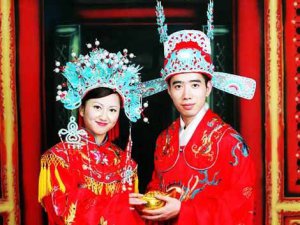
This guy will get a Xiao San in five years when he looks back and sees what his bride made him wear on their wedding day.
Even television shows and movies have gotten involved. There are a few shows that depict ancient Chinese concubines skirmishing for power, and a very popular Chinese show called Woju had the main female lead become a second wife. She had the wide-eyed innocence that most men in this culture love, but even as her plight became clearer to her, she maintained that she was in love with the guy (who happened to be a handsome, corrupt government official). SPOILER: This became a huge hit here in China, but it was eventually cancelled and the govt official died in a car wreck before he could be brought to justice, and the main girl lost her baby. So, in the end there was some sort of cosmic retribution or a concerted
Another, more recent film, Beijing Meets Seattle (Finding Mr. Right in English), is about a woman who goes to Seattle after watching “Sleepless in Seattle” too many times…well, not necessarily. She’s a pregnant second wife who wants her kid to be born in the States. While there, though, she falls for a stoic Chinese single dad. It’s sort of a boring film, but the themes and ideas in it hit on some pretty hot topics right now.
Despite his salt and pepper thing he’s got going on, they both look 12 on this cover…Beijing Meets SeattleTwo main characters from the show Woju.
How does this translate into reality?
Throughout Chinese history Emperors obviously had the best deal, right? I mean, there are some who had hundreds of concubines. Even the Tang emperor, Gao Zong is said to have taken pleasure in about 3,000! Like I said, mistresses, or girls on the side are nothing new, but it was actually quite frowned upon by Mao back in ’49, so the trend was wiped out.
There is a bunch of literature about this topic. You can find out all you need to know about this from any number of sources, but one recent article I read claims that economics is one of the factors that’s brought it all back in fashion. “Second Chinese Wives are Back,” writer, Olivier, says of the Chinese men who have made a buck:
Their social progress is seen by their many luxury expenses (car, travel, home etc.). But now, they consider that it is not enough. The best way to show its rank is the maintenance of young and pretty mistresses. The modern cohabitation thus comeback! This phenomenon is spreading so fast that in most major Chinese cities, there are “concubine villages”, with buildings housing luxury apartments where young women maintained their spending and gifts : jewelry, wardrobe, new technologies…
Villages, man! I know that business men in Hong Kong stick their Er Nai/lai (second wife) in the neighboring city of Shenzhen, but I wasn’t aware of villages. My girlfriend, Xiao Ming, even told me that a lot of second wives get a specific car from their sugar daddy—a BMW—and the first wife (kinda sad that we’ve gone back to numbering them like they did back in the ancient days. What are they, Mormon?) will get a bigger SUV or something like that (I guess it’s so she feels secure in the fact that if the little hussy is too much trouble she can run her over?). Some girls even use this catchy little phrase to sum up their chosen path, “I’d rather cry in a BMW than laugh on the back of a bicycle.” The BMW is such a common purchase for this little set up that it’s jokingly referred to as “Bao Ma” or “precious horse,” because, as Xiao Ming explained, you mount both.
The article hints at this, too:
This relationship is organized as a win-win situation. The trend of these new wives is so fashionable that luxury cars have named a segment of their range “car mistress” (often flashy sports cars).
For example, Jian, a 42 years Chinese businessman at the New York Times says “Having a mistress is like playing golf. These are two expensive hobbies”. To maintain his extramarital affair with a 20 year old student, he spends about 4,500 € per month.
He bought this for me because he admires my gumption …
Expensive is right, but not just for the man, and not just in regards to cash. I have a friend who was a second wife for a few years while living in Shanghai. As you can imagine, when I learned of this I had a ton of questions, but I couldn’t just interview her about the relationship. Over time I got most of the story, though.
After college she met this business guy, and really liked him, so she moved to Shanghai to be with him. She dealt with her qualms about him being married by focusing on the time they spent together. He bought her jewelry, a car, clothes, etc. This went on for quite some time, but she wanted more. She lied to her family about what she did, who she dated, and it took its toll. More than anything, she wanted to be with this man “for real.” Then he wanted a baby. His wife had a health problem, and he wanted my friend to trust him. So she agreed. She became pregnant and he bought her a 2Million RMB apartment. Things looked as though they were going the way she had always dreamed, but when he disappeared for an extended period she became distraught. She suspected that he had another girl. When he did resurface, he made her get an abortion, saying that he wasn’t ready even though she had already conceived. After that, the illusion broke and so did her spirit.
Shortly after that she returned to Dalian and, with the help of her uncle’s guanxi and some forged documents, got a job. If there can be a silver lining it’s this: the man put her name on the lease of the apartment. My friend used this to her advantage. She put it up for sale and just two months ago it sold, making her quite financially comfortable.
She’s a very strong and passionate woman, but she’s cynical, angry, and hurt. You can see all of this if you take the time to get to know her. I wonder how much of the pain is from her decision to be with the man and all that transpired because of it.
Is it worth it…?
It’s not just the uber-rich or highest level officials in big cities that have these second wives. Here in Dalian my girlfriend’s father has a brother who just asked him to help him deal with his second wife. Apparently the second wife is just causing a stir and the man needs some advice…you know, beyond the obvious. This man works in construction, and though China loves tearing up roads they have just paved, the construction market has already seen its hay day.
If you’re thinking all men are pigs, think again. Some of the wives know of the Xiao San and let the man do as he pleases as long as he’s a capable provider. Some will even take on a man of their own. The term for the wife’s boyfriend is Xiao Bai Lian, or little white face. He’s the strapping young buck who tends to the woman’s needs while she provides him with clothing and everything else so he can just have a leisurely life. Basically, the husband is paying for his second wife and her financial needs, his first wife and family’s needs, and her boyfriend’s needs.
This cultural trend is not just casually accepted by all. Of course, many women despise the practice, and the men who have a bit more integrity are frustrated over it, but it does happen. It is talked about, joked about, and parodied on the big and small screen. In ’09 some 95% of corrupt officials were reported to have had second wives, for crying out loud! Some corrective measures have been enacted, though. Government officials have been asked by Hu Jintao to curb their lust and, “…refrain from all young women temptations,” classes in HS have even been implemented to teach young girls to value themselves and have higher standards, and hell, a vice mayor of Hangzhou was executed because of corruption charges and he had more than a dozen mistresses.
…I may have had sexual relations with (those) women…
Economics is a factor in all of this, but some people like to blame another one: Western influence. This just frustrates me to no end and makes me want to gouge eyes out with chopsticks. Take this little new trend that’s apparently catching…
Starbucks has become a place for casual pick-ups. Not like a good place to meet people, no, people come here by themselves, to find other like-minded individuals, and find somewhere to get it on. The way it’s been explained to me is like this. That dolled up, cute girl or that slightly older attractive woman sittin’ by herself playing on her phone…she’s probably scanning Weixin (a messaging system that uses texts, pics, and audio) to make new “friends” in the area so they can hook up. The guy who is glued to his phone, but looks up every time the door opens, yeah. I know women and men who have admitted to getting together this way. Some of them are single while some of them are attached and just lookin’ for something more. I asked one guy why they do this at Starbucks, and he said it’s because it’s a Western place. Granted, this is just his idea, but he didn’t hesitate to express it.
Not enough girls…let’s jam.
I’m not judging the behavior; I’m just annoyed by the perceived motivation behind the venue. Whatever. Western men already get stereotyped as playboys and worse here. What I do get pissed off about is when guys with these cavalier attitudes directly cross my path. Four times already guys have tried to pick up Xiao Ming after knowing she was with me.
The first time was with my old landlord. Remember him? I mentioned him when it happened. He has a wife in Japan, but that didn’t stop him from telling Xiao Ming he loved her. When Xiao Ming laughed and told him she didn’t have any feeling whatsoever for him he became a dick.
Another guy was the manager at the gym on the fifth floor of An Sheng shopping center. At first he asked her the normal questions about filling out membership stuff, and then after she did, he began asking if she had a boyfriend. When she said she did he seemed excited and kept asking her to bring me along so I could join (he’d comp the first few times for me, he said). She thought he was just being a salesman. Then he kept following her around when she’d go there to work out. He’d open conversations with questions about me. What I did, all that…When he learned I was an American he asked her how we communicated. Xiao Ming has a wicked sense of humor, and responded, “Wai guo ren ye shi ren.” Foreigners are also people. He concurred, and walked away. Later, a few days after that, he sent her a text asking how long we’d been together. She exaggerated so he’d get the hint and said a year. He then responded, saying that he didn’t have a chance. That was the last communication they had. We both laughed at the lack of tact on his part, but it was annoying anyway.
The next guy hasn’t out and out asked her to be with him, but he’s a bit older and possibly more cunning, but not by much. She met him when she and her cousins and aunts went to KTV. He’s the friend of her aunt or something. Well, that night nothing happened at all. But then a week later, Xiao Ming and I run into him at a bar. The two of them chat a few minutes and I chime in here and there, but then we go our separate ways. At first I thought nothing of it, but then when he said, “Oh, I don’t want to disturb you two,” and Xiao Ming responded, “You’re not disturbing us. We’re together all the time,” I had to wonder. I asked her why she added that. Not because it wasn’t true, but because I could tell it went beyond her normal pattern of speech. She said she felt a little strange when he looked at her.
He had shown an interest in French culture, she said, and when she told me that he’d begun texting her about this I told her to watch out. He even began one line of dialogue by saying I was handsome. What the hell is that about? I explained what he was doing and she saw it, too. The guy did have a bit more tact, going at her through an intellectual route, but it wasn’t going to happen. And then a week later I had dinner with a buddy of mine and then a drink. He and I were having a good time when Xiao Ming texted me and wanted to hang out. She told me that she’d just stepped into one of our favorite places and the guy was there. She told me she thought I should head over because he was talking about using her as a translator on his next trip to America. She laughed about it, on her guard, and when I showed up the guy’s eyes got a little wide, and then sad. I walked over, made it obvious she and I were together, and then joked about him in English with her. She cracked up, and I let the two of them continue chatting for a bit. Then I started picking his brain on where he was traveling to, made some recommendations.
When he tried to tell her that he’d pay for everything, that he’d even sleep on the floor, it was my turn to crack up laughing. He spoke in Chinese, but I had understood and told him it wasn’t happening. Soon after that he and his pal left and Xiao Ming, my friend, and I all kept having a good time.
The fourth guy went about things a bit more discreetly but more explicitly, and that’s why I am still waiting for a chance to see the little bastard. I met this guy first, about a year ago in Starbucks. He and I are not close friends, but we’re at that superficial, by-you-a-round-shoot-the-breeze level. Ever since he and Xiao Ming exchanged numbers (something she only did because she felt that, as my friend, he was ok) he had a thing for her. She told me that he once made an inappropriate joke about sleeping with her and that she had shut him down rather harshly, saying that if he said it again they would never talk again. That was the end of it until recently.
He’s moving back to Shanghai this month, a move to change his boring, lonely life, he says. This has made him rather desperate, I think. One night while Xiao Ming and I were out, we met up with him and two others for a drink. We hung out a bit, but then she and I wanted some food. We told them we’d meet up later. After food, though, we just wanted to hang out on our own, so we told him we’d catch him another time. Then, as she and I were playing pool (we are two of the worst players ever) her phone is lit up with weixin messages. She’s annoyed, I could tell. Her face took on that pensive look she gets.
When I asked about it she reluctantly said I shouldn’t be angry, that he’s just lonely. Apparently he kept asking her where she was, where she’d be staying tonight, and then flat out asked her to spend the night with him. She responded to each of these with irritation and told him that she wasn’t like that, that she was with me. He said it’d be just their secret, but she refused, saying that she’d know, and that she only thought of him as a friend, and now not even as that. I was livid. Man, I wanted to deck him right in his fat face, but I let it go…for a bit. At the time I was just focusing on making her feel better because she felt pretty upset about the whole thing. She wondered what it was about her, what was she doing to get this sort of attention…
I made jokes, I soothed her, I praised her, but I couldn’t let go of one thought: it was me. It’s true, she’s a great woman, and embodies all the ideals of beauty that Chinese men seem to value, but I’ve had the sneaking suspicion that when they see her with me, a young American, some Chinese men automatically judge her based on other preconceived notions of these types of pairings. Suddenly her status is in this hectic blender that they have no right to put her in. I don’t care about the looks I get, but shit, it really irritates the life out of me when I see first hand how this crap affects her. I haven’t gotten a chance to run in to this maggot since that night, but even if I do, I’m not sure how I’ll handle it. My first instinct is to break bones and listen to the snaps, but I’m in China. I may just make it obvious that she’s told me everything, and enjoy the fear in his eyes. Xiao Ming says to leave it since she’s already taken the rest of his Face, but the Y chromosome in me wants to exact masculine vengeance.
I fear I’ve stumbled off into a digression. Please forgive me, and understand that I am not holding any of this up as a general statement of how things are here, but rather as an indication that people can be douche bags on every continent.
The other day someone asked me six different questions about being here, my work, and just what I thought….I decided to post my article on here as well.
I’ve also posted this in the “What you need to know” section of my blog because I think it fits there nicely.
My name is Jordan and I’m from Ohio, but for nearly two years I’ve been calling Dalian, China my home. I came over here with the expectation of staying for one year before returning home and getting an “adult” job. One and done, that’s what I kept telling myself, but before long that mantra became like a propaganda tactic that I really didn’t need or want to listen to. When my one year contract came to a close, I decided to stick around another six months. My coworkers were excited, and my supervisors didn’t need to replace a Western teacher (an arduous process here). So I settled back in and enjoyed the time.
I absolutely loved the training school I worked in for the first year and a half—the other teachers, the Chinese staff, the students, and even the building had a unique appeal to it that I will never forget. I enjoyed the walk into work on the nice days, and the convenience of my apartment’s central location. Dalian proper is definitely an urban setting with all the pros and cons of one. You’ve got access to just about any kind of cuisine, attractions, shopping, good public transportation, and parks. You also get great big whiffs of exhaust from all the traffic, the grit and grime of a city getting over populated, and the general chaos associated with a metropolis on the rise. But I don’t live in the actual Dalian city.
Dalian’s Development Zone, or Kaifaqu, is a twenty minute Light Rail Train ride north of the city, and has a much slower, almost quasi-urban-suburban feel to it. I love it. Everything I need is within walking distance, but for those lazy moments the ubiquitous taxi or bus is always available, too. While still technically a part of Dalian, Kaifaqu has its own aura. Seriously. Stationed so close to the coast, there’s always a sea breeze to cool you down, and though the beach is rocky, there’s plenty of swimming in the summer. When I first got here I wandered around, a lot. I took walks almost every evening, just to get a good look at the place. I walked at all hours, usually by my self even though a few coworkers chastised me for doing so at late hours. Even with their warnings, I felt safe. I still feel safer here than I did in my home town.
In the summer, when the heat is too much and you don’t want the stony beach of Kaifaqu, Golden Pebble Beach to the north is the place to go. Just a fifteen minute Light Rail Train away is the “ritzy” side of Dalian. All of Dalian has a large amount of foreigners from all around the world working with many different companies, but in Golden Pebble Beach there are a lot of North American teachers of all disciplines. Two international schools with great reputations entice them to stay a few years, but the area also has a few other cool features. There’s a nice beach, an amusement park, and it’s one of the only places you can escape the curse of one of China’s most well-known idioms—People, mountain, people, sea (ren shan ren hai). The crowds haven’t quite made it up there, but in a few years we’ll see. Plans to move Kaifaqu’s center closer to Golden Pebble Beach have been put into motion, and China loves construction.
My certification as a Secondary Integrated Language Arts teacher has come in quite handy, and is really the big reason I’ve been able to seek other employment opportunities in the area. To get here, however, you don’t necessarily need anything but a Bachelors degree. China has been making it hard to get over here for anything more than tourism, but it is possible. Get your degree, passport, and jump online and start applying. I went through Footprints Recruiting, and they worked as a liaison between me and the first school I worked at. Not only that, but their website www.footprintsrecruiting.com and their Facebook page https://www.facebook.com/FootprintsRecruiting have a wealth of information about China and other areas around the world that regularly have postings for teachers. Going through an agency like Footprints put me in contact with a trustworthy school in the smoothest way possible.
Though I hold credentials for the high school English classroom, the majority of my students the first year were under the age of twelve. At first I wondered if I had what it took to be in that age range, but after just a few classes my hesitancy fell to the wayside. Learners here are a different breed of student, and for the most part that actually works to a new teacher’s benefit. Respect for elders, the desire to earn the teacher’s praise, and their peers’ admiration are three elements I’ve noticed that sort of collude to make the classroom a politely controlled and often hassle-free space. I had to design classes around asking questions just to get them to raise their hands and let me know what they were thinking! Once they get to know you, though, it’s anybody’s guess how they’re going to behave. I have kids hug me, poke me, try to use qigong to (play) fight me, and ask me to throw them into the air between classes or when we have a break. They like to give gifts, and it was only after a few stomachaches and colds that I realized I needed to stop accepting the damp cookies and candies they were handing me with their dirty hands.
I’ve gotten to teach some memorable lessons, including one about Mexican food like tacos. At the end of the unit about Mexico, I decided to have the class make tacos for real. I readied the ingredients: lettuce, tomatoes, tortillas, cheese, olives, and I even fried up some beef. After teaching the vocabulary and the instructions for the receipt we dug in and made them. We snapped photos and the kids had a good time putting their tacos together, but not all of them grasped the concept of how to eatthem. Some students nibbled on the very top of the tortilla where there’s no filling at all while others munched on the middle of the bottom. The ladder resulted in a few messes as the filling just spilled out! Still, others placed the taco on a plate and used a fork and butter knife to cut into it. I let them play around until finally I showed them the right way to eat them. After that, we all enjoyed our tacos the right way.
Seriously…one of my favorite classes I’ve taught here at Jayland this year.
My time here has been filled with experiences like that, some inside the classroom and many outside. The clash of the cultures isn’t so much a clash as it is a constant blending that a lot of the times results in humorous misunderstandings and always something learned. Everyone will have a different experience, though. No two are ever the same, and the location will affect this in a multitude of ways. Depending on what province or city you’re in, China will present you with plenty of opportunities to make your own stories.
During my time here I’ve gotten to see a handful of pretty cool places. I’ve visited Beijing and seen the Great Wall and the Forbidden City, Xi’an and the Terracotta Warriors, and even Luoyang and the Longmen Grottoes. Natural sights such as sacred Hua Mountain and the beautiful scenery of Guilin and Yangshuo are fantastic, too. Even old Song Mountain where the Shaolin Temple has stood for hundreds of years is a wonderful destination. But if you’re going to live in China, I truly believe that Dalian, and even more, Kaifaqu, is one of the best places you can be. Dalian is a young city by Chinese standards, but it has an interesting history, great parks to see, a nice zoo, some beaches, a lot of job opportunities, some friendly and open people, and I would recommend this coastal city to anyone. No matter where you go, people will always want to get out, to travel. I talk with people all the time here who just want to see different areas of China. They don’t know why I like it here so much, but I tell them that one man’s back yard is another man’s adventure. And I’m still having a great time.
Getting the qualifications and choosing a destination are two big steps to moving abroad, but I would offer a few pieces of advice if you’re looking to take the plunge for an extended period. Before going to a country check out their internet set up. Is it monitored a lot? Get a VPN (Virtual Private Network). This can be the thing that saves your soul, or at the very least allows you to get accurate world news. There are plenty of options available to people for this kind of service.
My second piece of advice is, that even before you arrive, cultivate a habit of observation. Read about the country you’re going to. Do research. Then when you get there just watch and listen. A lot. Do a lot of observing with all your senses, and just try to refrain from passing judgments of any kind. This is a much harder task than you’d imagine, but I challenge you to do it. I’ve heard a ton of foreigners here complaining about one thing or another, but many of them haven’t been here more than three months. Don’t get me wrong, some of the complaints are valid, but certainly their day would improve if they spent the time trying to understand what confused them instead of immediately venting about it. The reward for this? Understanding, awareness, changed or improved perspectives, and you could quite easily make a bunch more friends by being willing to learn all the angles to this new culture in which you find yourself.
Developing and maintaining a sense of humor is paramount. Smiling when you want to curse the world is a skill not only useful for becoming a saint, but for dealing with the other seven billion people roaming around on this Earth. Laughing at an exchange that sees you shorted 50 RMB or on the wrong side of the city at an inconvenient time is, I would argue, the most versatile and practical skill you could have in your arsenal.
I didn’t come to China to get rich; I came to learn something about the world and myself. I have succeeded in ways I could never have imagined, and I know I am not an anomaly in the abroad community. Living and learning in a place that is so different from where you used to call home has a mystifying way of altering you, changing you into something new. My last piece of advice is a fun thing that you can only do when you make a big change. By moving abroad and settling into a different place you get the unique chance to reinvent yourself. That person you’ve always wanted to be? Now’s your chance.
We live in an increasingly interconnected world of high-speed downloads and uploads, of text speak and netizen culture that sometimes bleeds into the actual 3D world of reality. Here are some of those tidbits that I’ve noticed while here in China…
Ten Internet Memes or Phrases that I’ve been hearing a lot in Dalian.
给力
Gei (3) Li (4)—This expression is a relatively new one that got its start right online in Chinese forums and chats. Its two characters translate to “give” and “power,” and it basically has the same meaning: to give power, to make something interesting or impressive, awesome…”
I used this once, and my friend just laughed and wondered how I knew it. Last year I heard it more than this year, but I’m told it’s still out there. You can also hear “Jia You,” which basically means, “Good Luck,” or “You can do it.”
2) 高富帅
Gao (1) fu (4) Shuai (4)—This phrase means tall, rich, handsome, and is the pseudo-standard Chinese women use when searching for that special someone. They want a tall, handsome guy with access to cash. I hear this phrase all the time, and even in television shows. While it may not be the exact blueprint for what is desired by all, it certainly has a lot of traction, and everyone knows of it.
Every time this sort of topic comes up in conversation and I say it, the girl usually acts surprised that I know of it, and then enthusiastically nods her head in agreement.
3) 白富美
Da ge r, piaoliang, bai OR Bai, Fu, Mei—Tall, pretty, white is the phrase that is the male equivalent to “gao, fu, shuai.” The whole of Chinese culture values white, pearly skin, as a lot of the world knows, but it’s one thing to think, “Oh, Chinese like pale girls,” and it’s another thing entirely to go to the beach and see people hiding out in tents, wearing full-body suits, or wearing heaving clothing in 90 degree weather, and carrying sun-brellas around during the day.
Even if a girl has gotten the tiniest bit of sun—say an hour or two—someone close to her will notice and say, “ni zen me zhe me hei?!” How are you so black?!
We’re so tall and rich that we put our wads of cash on the top shelf. Did I mention that we’re so good looking we can trick short people into climbing over one another to fetch our money from those shelves?
4)
The numbers: 2, 250, and 38—er, er bai wu, san ba. The number two has taken on the meaning of “stupid, dumb,” whereas 250 describes a foolish person. 38 is actually a bit worse because if you call a man a “san ba” you’re basically calling him a bad woman or an annoying gossip, or even a “biaatch.” Not at all nice.
Merchants will go out of their way to make prices anything else but 250, just to avoid the implied meaning of calling their customer an idiot. And lately young people have added some math into the mix: 2 + 250 + 38= 290. If you hear someone calling you er bai jiu shi they’re not saying anything nice, trust me.
He gets it…
5) 很黄很暴力
Hen (3) huang (2) hen (3) bao (4) li (4)—This phrase means, “very yellow, very violent.” A woman who was interviewed on a Chinese news channel used the phrase to discuss violence and pornography, and people just kept it going.
In Chinese something that is “yellow” has the stigma of being explicitly sexual or dirty. You have yellow jokes, yellow movies, yellow man, yellow woman, etc. You wanna be careful because this one is used often, and everyone knows the connotative meaning of yellow here. “Bao li” means violent, which sort of goes hand-in-hand with some of the topics.
6)
囧 jiong (3) is a character or pictogram that means embarrassed. The strokes look like a face making the embarrassed look. This is used a lot online because people can see the face, although I’ve heard a few middle schoolers say this at Starbucks.
Another similar one is “Orz” because it looks like a human bowing.
7)屌丝
Diao (4) si (1)—loser or even “douchebag.” This word got its start on a Baidu discussion forum, and describes someone who is poor, ugly, short, good for nothing, a failure in life, and even prone to excessive masturbation. It has become a popular term similar to the Japanese term “otaku” and can be used to refer to both males and females.
I have only heard this one once or twice, but I think it’s used online more than in actual conversations.
8)蛋疼
Dan (4) teng (2)—Ball Pain is a phrase that, well, men use, to describe uncomfortable situations, pain, irritations, or just annoyance. In Chinese the testicles are often referred to as “Dan” or “egg” for some reason.
This is a new one for me as I have yet to hear it, but Xiao Ming jokingly told me about it a few days ago. She’s heard locals say it a few times.
9)神马都是浮云
Shen (3) Ma (3) Dou (1) Shi (4) Fu (2) Yun (2)—God’s Horses Are All Passing Clouds. This phrase can be translated into “nothing is permanent” and the implied meaning is that we should all just chill. This has become a popular catchphrase for the youth or the “fen qing” emotional youth.
10)草泥马
Cao (3) ni (2) ma (3) –Grass Mud Horse. The Grass Mud Horse is a Chinese “netizen” symbol of resistance against the government’s control and online surveillance. It got insanely popular in 2009, and just kept going. It’s a homophone that sounds almost exactly like the Chinese “Fuck your mother.” The phrase is ultra-negative, of course, but my friends tell me it has even more feeling than the English phrase of the same wording.
Everyone knows that the Chinese net is policed by the govt., but most in the international scene don’t know just how much. For years now young people, artists, activists, and bloggers have led a campaign to take back their right of expression (in all forms), and the Grass Mud Horse just happened to be a mascot they could rally behind.
The GMH is a species of Alpaca, apparently. There were stuffed animals made, people paraded actual alpacas around in the streets, and a song was even made.
Let’s upload some social commentary on Xi Jing Ping…. Ok, then let’s talk about the Diaoyu Island… Oh, good, after that let’s take pictures of our muddy butts and post them on Wei bo.
Ai Wei Wei, an artist, made big waves because of his dissent and artwork, but he’s just one name among many.
Is that an Alpaca between your legs or are you just happy to be out of prison?
I can’t even look up certain Yahoo! News articles here (I know, why would I even go to Yahoo for the news, right?). Simple things like air quality measurements to sensitive things like ANYTHING WITH POLITICS and some historical facts are all banned. I’m only on here now thanks to my VPN.
Yes, you can say that Chinese culture is still very conservative regarding a wide range of topics, but more and more, today’s young adults are pushing back and, in some cases, breaking those perceptions. Many of the people I’ve gotten to know during my time here are between the ages of 19-30, and most of them can’t stand the censorship or hypocritical nature of the government’s policy’s and officials’ behaviors.
Here the Cai Ni Ma is being confronted his arch-nemisis, the river crab (in Chinese Hexie, which sounds like “Harmonious” in Madarin. Yes, another homophone.) Credit: Jessi Wong, image size 10x15cm, lino cut on paper 2010. Printed as part of the “Impressions” exhibition at the Australian Print Workshop.
But…so far, the fight is largely relegated to the virtual world where “50 Cent armies” commissioned by the govt. to perpetuate propaganda scour the web to shoot down dissenting voices, sites are shut down by agencies, keywords are monitored for sensitive topics, and the citizens are forced to use internationally-based servers just to get the news about their own nation.













































 Wandering But Not Lost